
Grady County Arrest Records and Charges
Arrest records begin with law enforcement. In Grady County, the sheriff's office and jail are at 115 16th Ave NE in Cairo, with Sheriff Martin "Earl" Prince listed in local sources. The sheriff site identifies staff roles that include a Warrant Clerk/GCIC TAC, which is useful for warrant and arrest-routing questions. Jail booking information belongs on the custody side, while formal court charges belong in the court case file.
The charge record begins when the prosecutor or court files the charge after arrest. A single arrest can lead to no filed charge, one filed charge, several counts, amended counts, dismissed counts, or a later conviction. For custody and booking-route detail, use inmate records. For the full case file with plea, disposition, and sentence, use criminal court records. For broader civil, probate, traffic, and family files, use court records.
The county sheriff image assigned to this arrest records page comes from the official Grady County Sheriff's Office county page.
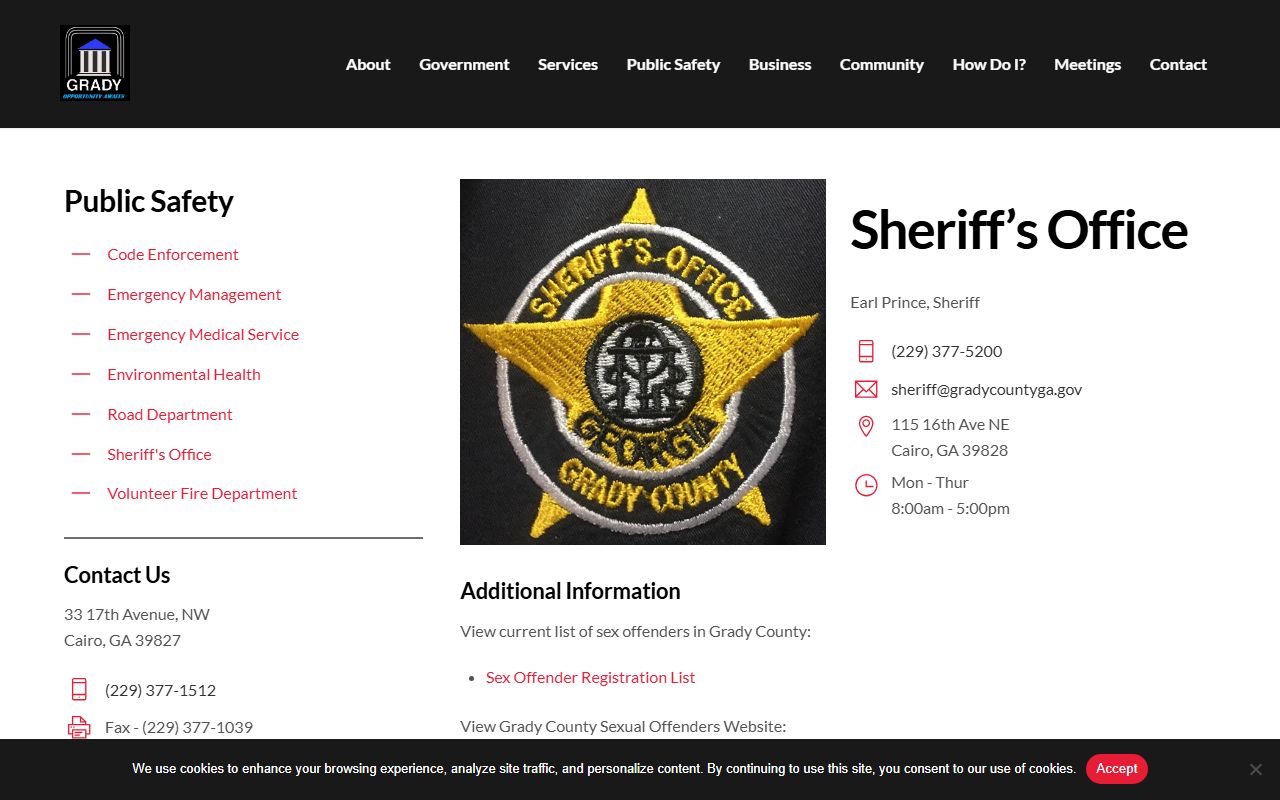
That source is the county-level starting point for sheriff contact, sex offender links, and local arrest-related routing.
Find Grady Arrest Records
No official public Grady County Georgia web jail roster or public active-warrant list was located in the inspected official sources. That makes the access chain important. For arrest or booking status, call the Sheriff's Office/Jail at (229) 377-5200 or use official sheriff channels. For formal filed charges, ask the Clerk of Court for Superior, State, or Juvenile Court records. For Cairo city traffic or ordinance charges, contact Cairo Municipal Court through the City Clerk.
- Start with the record type: booking, warrant, filed charge, court docket, sentence, or registry record.
- Use the sheriff for arrest, jail, warrant, and custody questions.
- Use the clerk for filed criminal charges, docket status, disposition, and certified court copies.
- Use the prosecutor or solicitor when the question is about charge filing, amendment, dismissal, or restriction eligibility.
- Use statewide systems only for their own slices, such as GBI restriction guidance, sex offender registry data, or GDC sentenced-offender records.
The newer sheriff site image assigned to this page comes from the official Grady County Sheriff's Office website.

The new sheriff site advertises public news, alerts, and MySheriff mobile app messaging, but the research did not confirm an app-only arrest, inmate, or warrant search feature.
Charges After Arrest
Charges after arrest appear through charging documents and docket entries. Georgia criminal records may use terms such as accusation, indictment, complaint, warrant, or citation depending on court type and offense. The South Georgia District Attorney handles felony prosecution across the South Georgia Judicial Circuit. The Solicitor-General is relevant to State Court misdemeanor and traffic prosecution where applicable.
| Document | Filed By | Common Use | How It Affects Records |
|---|---|---|---|
| Complaint | Officer, prosecutor, or court process | Initial criminal or warrant-level allegation. | May start or support early court activity and probable-cause review. |
| Accusation / information | Prosecutor | Prosecutor-filed charge, often without grand-jury indictment. | Creates or updates the formal charge list in the court file. |
| Indictment | Grand jury | Serious felony prosecution. | Sets the charges returned by the grand jury for Superior Court prosecution. |
Charge documents should be read with later docket events. A listed charge may be pending, amended, reduced, merged, dismissed, nolle prossed, or resolved by plea or trial. The final disposition line is what tells whether the filed charge led to conviction or another outcome.
Grady Charge Status
Charge status can change several times. A prosecutor may file a different charge than the arrest label, add counts after review, reduce a felony to a misdemeanor, dismiss one count while keeping another, or enter nolle prosequi when the state declines to continue that charge. Do not treat the first arrest label as the final court outcome.
| Status | What It Means |
|---|---|
| Pending | The charge has not reached a final disposition. |
| Amended | The charge text, count, severity, or statute has changed. |
| Reduced | The charge has been lowered, often from a more serious offense to a lesser offense. |
| Dismissed | The court or prosecutor has ended the charge, with or without limits on refiling. |
| Nolle prosequi | The prosecutor declines to proceed on that charge. |
| Convicted | The charge ended in a guilty plea, guilty verdict, or accepted conviction result. |
Charges vs Convictions
An arrest can be real even when no conviction follows. A charge can appear in court even when it is later dismissed. A conviction requires a guilty plea, guilty verdict, or other conviction result accepted by the court. For Grady County arrest records and charges, the safest reading is to separate arrest, filed charge, disposition, and sentence.
| Topic | Charge | Conviction |
|---|---|---|
| Timing | Filed after arrest or prosecution review. | Entered after plea, trial, or final court action. |
| Meaning | An allegation in the court record. | A legally accepted finding or plea of guilt. |
| Can change? | Yes, it can be amended, reduced, dismissed, or nolle prossed. | May later be appealed, modified, restricted, or sealed if law allows. |
| Where to verify | Clerk docket and charging document. | Disposition, judgment, sentence, and clerk-certified record. |
Warrants, Bond, and Holds
Warrants often sit between an arrest record and a court charge record. Grady County research found no public active-warrant list, but the sheriff site lists a Warrant Clerk/GCIC TAC. Georgia.gov warrant guidance says people should contact the sheriff's office for existing warrant information and should have first name, last name, date of birth, and county ready.
Magistrate Court may issue arrest or search warrants and handle preliminary criminal matters. Bench warrants may arise from missed court dates in Superior, State, Magistrate, or Cairo Municipal Court. If a person appears in person with an active warrant, immediate custody may result. Call the proper office before assuming an online payment or case search clears a hold.
Note: A bond amount in a court or jail record does not prove final guilt or case outcome.
Statewide Charge Lookups
Statewide systems answer narrow questions. The GBI criminal history restriction page explains how criminal-history access can be limited under O.C.G.A. Section 35-3-37. The GBI sex offender registry guidance and state registry search concern registry records under O.C.G.A. Section 42-1-12. The GDC offender search covers sentenced state prisoners, not local Grady County jail bookings or every court charge.
OffenderWatch was listed in the research as a sheriff-linked sex offender search, with fields for address, city, state, ZIP, ZIP+4, and address type. That tool is a registry search. It is not a general arrest database, and it is not a full criminal court docket.
Recent Arrest Context
Recent law-enforcement news can explain why an arrest or investigation may appear in public discussion before a final court record exists. It should not be treated as proof of conviction. Research identified a June 12, 2026 GBI officer-involved shooting investigation requested by the Grady County Sheriff's Office. It also identified June 2026 local reporting about a drug investigation and February/March 2026 reporting about a former detention officer arrested in a contraband and bribery investigation. Those items are arrest or investigation context, not final court outcomes.
The GBI image assigned to this arrest and charge page comes from the June 12, 2026 GBI Grady County officer-involved shooting release.
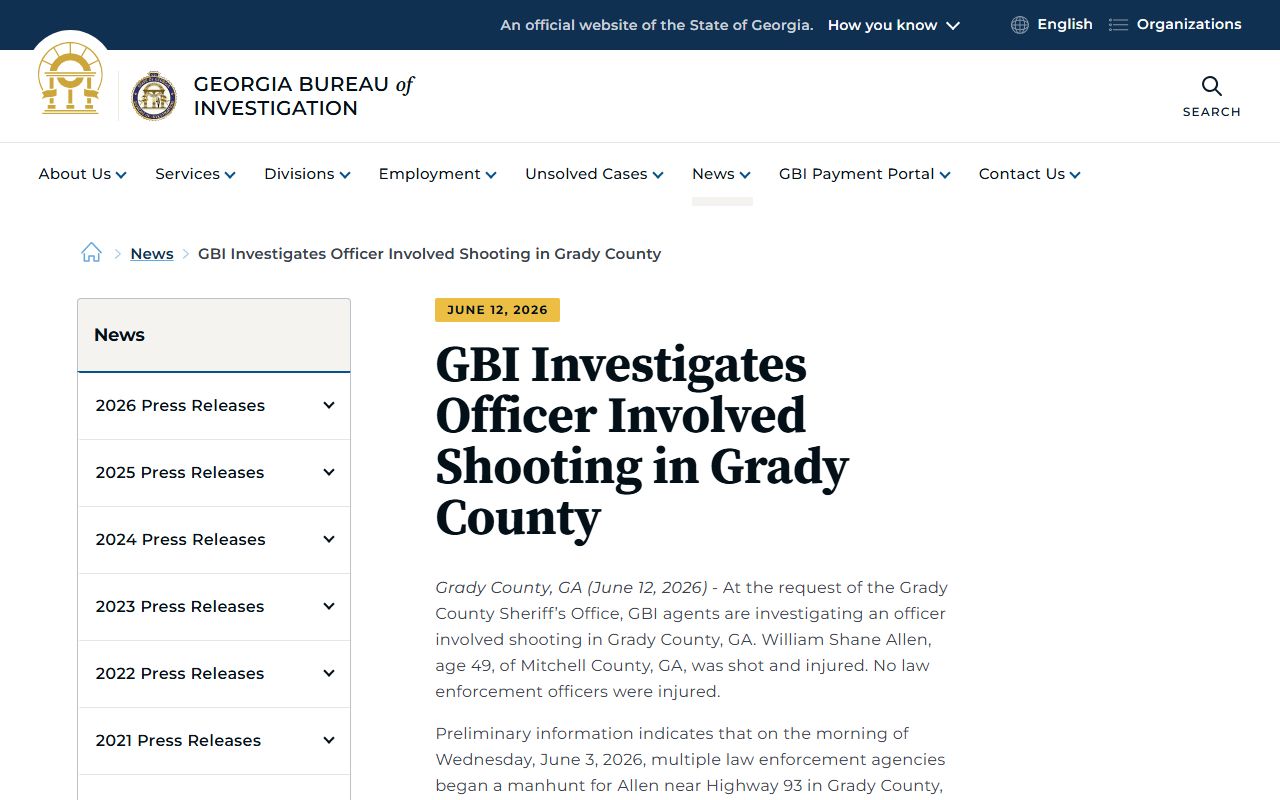
That release is useful for separating an investigation notice from a filed charge, plea, or conviction in a Grady County court record.
The WSB-TV image assigned to this page comes from the 2026 report on a former Grady County detention officer arrest.

Use dated news only as context; official charge status and disposition must come from the court, prosecutor, or clerk record.
Restricted Arrest and Charge Records
Georgia record restriction can limit criminal-history access, but it does not always seal every court document. GBI says arrests after July 1, 2013 generally route through the prosecutor for restriction, while pre-July 1, 2013 arrests may require application through the arresting agency. If the goal is to seal a court file, a separate court petition or order may be needed.
| Topic | Restricted Criminal History | Sealed Court Record |
|---|---|---|
| Focus | Limits public criminal-history access. | Limits access to court filings or docket material. |
| Main route | GBI, prosecutor, or arresting agency process. | Court petition, judge's order, or court rule. |
| Common issue | Non-conviction, dismissed, or eligible arrest history. | Juvenile, sensitive, sealed, or court-ordered confidential files. |
| Verification | Confirm with GBI and the prosecutor. | Confirm with the clerk and court. |
Background Check Limits
Arrest records and charge records can be incomplete if read without final court disposition. Employers, landlords, insurers, lenders, and other regulated users must follow FCRA and applicable screening rules. A casual public lookup should not be used as a consumer report. Certified court records should come from the official clerk or court that maintains the file.
Important: Verify arrest, charge, disposition, and sentence separately before relying on any Grady County criminal record.